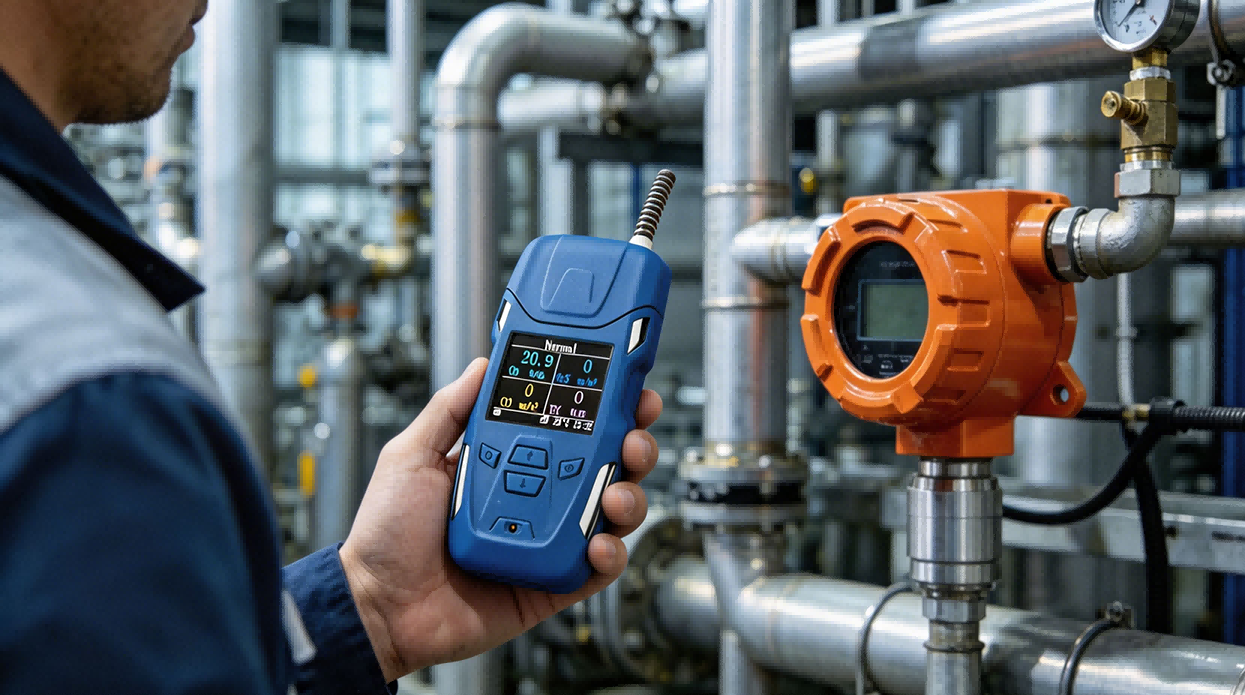
On-site gas detection at landfills is not a one-time task but a layered, routine practice. First, identify the high-risk zones: wellhead areas, leachate collection tanks, enclosed pump rooms, low-lying depressions and site perimeters near residential areas. Methane is lighter than air but tends to accumulate in confined spaces, while CO₂ and H₂S settle in low-lying areas, so monitoring points must be arranged at different heights rather than a single elevation.
Second, establish a tiered monitoring frequency. Daily walkover surveys should cover active working faces and gas extraction wells; weekly perimeter monitoring tracks off-site diffusion; and quarterly borehole sampling verifies deep waste layer gas composition. Always calibrate instruments before field use — landfill air contains high humidity and dust that can drift sensor readings over time.
Most importantly, enforce entry safety protocols. No personnel should enter a confined space at a landfill without a portable multi-gas detector and a buddy system. Stop all operations immediately if methane reaches 5% volume (lower explosive limit threshold) or H₂S exceeds 10 ppm, and initiate ventilation and evacuation procedures.
Choosing equipment for landfills means prioritizing environmental adaptability over raw precision alone. Start with explosion-proof certification — all instruments used in active landfill zones must meet at least Ex d IIB T6 rating, as methane-air mixtures create persistent explosive atmospheres.
For detection technology, infrared (NDIR) sensors are preferred for CH₄ and CO₂ measurement in landfill environments. Electrochemical sensors work for H₂S but degrade faster in high-humidity, high-dust conditions; look for models with built-in dust filters and water-repellent membranes. For full-site coverage, combine portable multi-gas detectors for routine patrols with fixed monitoring stations at wellheads and pump rooms for 24/7 continuous tracking.
Do not overlook data logging and connectivity. Equipment with built-in data storage and GPS tagging lets you map emission trends across the site, generate compliance reports, and identify gradual leaks before they become hazards. Finally, verify after-sales calibration support — landfill sensors require regular recalibration, and local service availability directly impacts long-term operational reliability.

 EN
EN
 CH
CH AR
AR BG
BG DA
DA NL
NL FR
FR DE
DE EL
EL HI
HI IT
IT JA
JA KO
KO PL
PL PT
PT RO
RO RU
RU ES
ES SV
SV TL
TL IW
IW ID
ID LV
LV UK
UK VI
VI TH
TH TR
TR FA
FA MS
MS SW
SW GA
GA BE
BE UR
UR BN
BN MY
MY SI
SI KU
KU